
The Reality of Venture Support
Why a Professional CEO Sought Coaching: Waterfront’s Organizational Reform Challenge Accompanied by a Coach for Two Years and Three Months
Mar. 06, 2026
.png)
Waterfront Co., Ltd. develops brands like “Waterfront” which features umbrellas with both functionality and design. The company is growing as a leading player in the umbrella industry. However, it was previously facing a major turning point, requiring management transformation in 2023, when Satoshi Yoshino, an experienced “professional CEO,” took over. Behind the trajectory of achieving a V-shaped recovery from a deficit and reaching record-high performance in the fiscal year ending December 2025 was “brainpower support” provided by JAFCO in the form of CEO coaching spanning two years and three months.
【Profile】
Satoshi Yoshino, CEO, Waterfront Co., Ltd.
After working at Isetan (now Isetan Mitsukoshi), serving as a buyer, and working for a financial subsidiary, he contributed to the establishment and multi-store expansion of “Estnation” at Sazaby (now The Sazaby League). In 2004, he moved to Fukuske Corporation during its management reorganization and served as president & CEO for 10 years starting the following year. During his tenure, he led M&A and overseas expansion, leaving after seeing the company become a wholly owned subsidiary. Subsequently, he served as president of the Towel Museum Group and external director at Soto Co., Ltd. He became Representative Director of Waterfront Co., Ltd. in 2023 and transferred it to TSI Holdings Co., Ltd. in December 2025.
Kazuki Tsuboi, JAFCO Group Co., Ltd.
After graduating from the Faculty of Management and Engineering at Tokyo University of Science, Kazuki Tsuboi gained experience in creating businesses and organizations while working at a human resource consulting firm, an IT startup, and companies such as Digital Garage and DeNA. He Joined JAFCO in August 2022. He works in the HR Support Team of the Business Development Division, where he acquires human resources and develops organizations in portfolio companies as an HRBP (Human Resources Business Partner). In addition, he supports individual growth through executive coaching, mainly for entrepreneurs and managers as a CEO coach. He is in charge of planning, operating, and interviewing for YouTube projects “The Startup Challenge” and “Inside the Vision.”
The Trap of “Omnipotence” Unique to Professional CEOs
―President Yoshino, I understand you have been receiving monthly “CEO coaching” provided by JAFCO for two years and three months since assuming office. Please tell us what prompted you to seek support.
Yoshino When I took over as president in March 2023, Waterfront was in a difficult phase, still feeling the effects of the struggle during the COVID-19 pandemic. In the fiscal year ended December 2022, the company had an operating loss of 66 million yen on sales of 1.4 billion yen. To be honest, the atmosphere inside the company was dark. However, as social activities recovered post-pandemic, sales began to return gradually. As we reached a turning point to draw a new growth scenario, we faced a major management challenge: the “transition to a self-running organization.”
The employees were all serious, but perhaps due to the strong top-down management by the founding president that lasted for many years, hesitation about whether they were allowed to decide for themselves appeared everywhere in daily operations. Just when I felt strongly that it was vital to create a corporate culture where managers in the field take the lead to think and act on their own, JAFCO reached out and told me that they provide coaching opportunities for executives, and asked if I would you like to receive it. I accepted.
―President Yoshino, you are known as a “professional CEO” who has achieved results in reorganizing several companies, such as the legwear company Fukuske Corporation. But you still felt that coaching was necessary?
Yoshino It is true that I have had experience managing several companies. But that’s precisely why I felt that I need coaching now. When you accumulate experience at the top, you inevitably start thinking, “I probably know the most about management.” The worst thing is to have a sense of “omnipotence” and lean toward self-righteous decision-making. I have seen situations before where a company falls in a strange direction because of that.
To keep updating my own “OS” and to bring in a third-party perspective at a time when the company was trying to take on new challenges, I thought it would be a good thing.
―So, it was a positive introduction from the start?
Yoshino I can talk about it openly now, but at first, I was a little wary (laughs). An image crossed my mind of it being a kind of surveillance, like “How will the shareholder JAFCO train me to increase corporate value?” In the past, I have experienced many situations where shareholders from different funds pressed me to produce results faster. However, that worry disappeared as soon as I received the first coaching session.
Tsuboi Before conducting coaching, we always have an opportunity for “pre-coaching” to align perspectives by explaining the purpose and methods of coaching. The coaching we provide is not “teaching” that educates or instructs on specific know-how, but rather aims to clarify the managers’ own thoughts and consciousness to lead to decision-making and behavioral changes that meet their goals. I remember purposefully asking Mr. Yoshino after giving that explanation, “Do you really need coaching?” For a battle-hardened manager like him, a formal dialogue holds no meaning. I thought it was important to thoroughly align perspectives on what coaching is and stand at the starting line together with him. After confirming his understanding, we continued coaching sessions once a month. We had a total of 26 dialogues until the stock transfer to TSI Holdings in December 2025.
Moving Deeper from “Doing” to “Being”
―What kind of themes did you discuss in the coaching sessions?
Yoshino The consistent goal throughout the sessions was “how to create a self-running organization.” We discussed creating the culture and systems for that, but as I received Mr. Tsuboi’s questions, the core gradually shifted to something internal regarding how I behave, namely “Being” (who I want to be).
Regarding management methods and actions, or “Doing” (what should be done), several options came to mind from my past experience. However, Mr. Tsuboi would ask even deeper questions like, “Who do you want to be?” and “Does that action align with the person you want to be?” Even when I was working on developing my number-two personnel, I found myself thinking only about what I wanted the other person to do. But through Mr. Tsuboi’s question, “How do you think you yourself should be to encourage the other person?”, I was able to return the vector of my perspective to myself. I was grateful for that.
Tsuboi In organizations where the manager’s influence is strong, there’s a tendency to feel that it’s faster and more effective to have people move exactly as instructed, and the surrounding organization becomes one that just says “yes” and does it. However, if you want to create the “self-running organization” that Mr. Yoshino aimed for, that leadership must change. How should Mr. Yoshino exert his influence on the organization? I threw that at him in the form of “questions” and “feedback,” getting to what’s deep down in him in a way that was optimal for the current organization. I continued the dialogue with the image of drawing “auxiliary lines” for thought.
“Staring from Afar”—The View Seen When Withholding the Urge to Intervene
Yoshino I tend to get caught up in details and want to interfere, but while talking with Mr. Tsuboi, I became determined that my ideal is to be a manager who trusts and delegates to members. So, how can I embody that image of a manager? In that thought process, the power phrase I received from Mr. Tsuboi was “staring from afar.”
―That is a very unique expression. Specifically, what kind of change in awareness was it?
Yoshino It means keeping your distance but continuing to direct your interest. It means having a strong awareness of the issues and watching quietly. It was about suppressing the urge to intervene and waiting for the managers to think and decide for themselves. In the sessions, we shared many times the difficulty of having the “courage not to speak.” In addition, we talked about “how facilitation should be” in meetings as a theme several times. It was a reflection on whether I was talking too much or whether I was robbing the other person of their thinking.
As a result of spending this time, changes began to be seen in the employees’ actions as well. I was deeply moved when I saw field members rejoicing together because an original product they planned sold on EC and reached number one on Rakuten. An organization that had previously focused on wholesaling started by making directly managed exclusive products themselves and was rejoicing in the results as their own achievements. It was the moment when the “self-running power” I wanted to create truly sprouted.
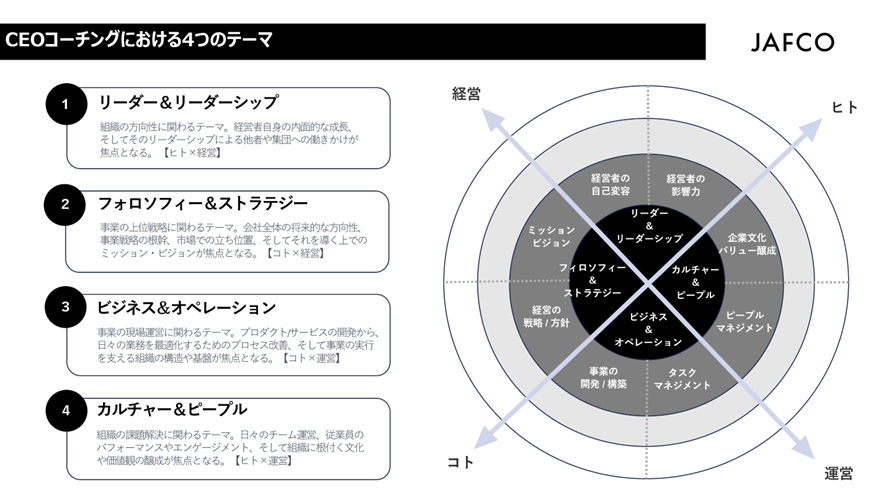
Tsuboi When I analyzed the content I recorded in approximately 500 hours of CEO coaching conducted over the past three years, I could classify the themes managers face into four major categories. Looking back on Mr. Yoshino’s sessions, there were many dialogues about his own “way of being” and “influence,” and I think a characteristic was the focus especially on “leadership” challenges.
―Mr. Tsuboi, is there anything you consistently keep in mind when coaching managers?
Tsuboi It’s the attitude of facing both “people” and “things.” It’s an image of refining the manager’s own way of being to move toward the results that should be aimed for according to the challenges of the time. In Mr. Yoshino’s case, to achieve the “things” challenge of creating a self-running organization, we placed the “people” challenge of his own way of being at the center of the dialogue as well.
Yoshino There was an unexpected event in the middle where a candidate for the number-two position left, but it was the power of coaching that allowed me to even grasp the problems with my own way of being that caused it from a bird’s-eye view. Utilizing the lessons from that time, a flow has now been established where next-generation leaders are naturally born from within the teams grown in the field. We took a detour, but I was able to get closer to my ideal management style. As a result, performance recovered rapidly, and we achieved record-high results in the fiscal year ending December 2025. I truly feel how meaningful it was to have time once a month to reflect on my way of being as a manager.
Supporting the “Essential Strength” that Leads to Medium-to-Long-Term Growth
Yoshino Mr. Tsuboi not only exerts the “power of inquiry,” but he also has extremely abundant knowledge regarding people and organizations. For example, as one of the pieces of knowledge used in talent development, he told me that there are multiple types of human sensitivity, such as “problem sensitivity,” “situational sensitivity,” and “interpersonal sensitivity,” and which one is strong differs from person to person. By being asked, “What type of sensitivity is strong in that leader?”, my thoughts developed further. Mr. Tsuboi gives me new perspectives by bringing out various frameworks and insights obtained from dialogues with other managers in that way.
Tsuboi If I can influence Mr. Yoshino’s thoughts by drawing “auxiliary lines for thought” from past experiences and knowledge, actions will naturally change and results will change. That’s my role. Beyond just organizing thoughts, I aim to provide support so that he can gain new perspectives and make them “usable” in actual management.
Yoshino Some funds have an attitude of rushing you to “produce results quickly,” but JAFCO is fundamentally different. They support the “essential strength” that allows a company to continue growing over the medium to long term. Not just through coaching, but including support for talent acquisition and sales operations, they polished us into a comprehensively strong company. I’m truly grateful for this.
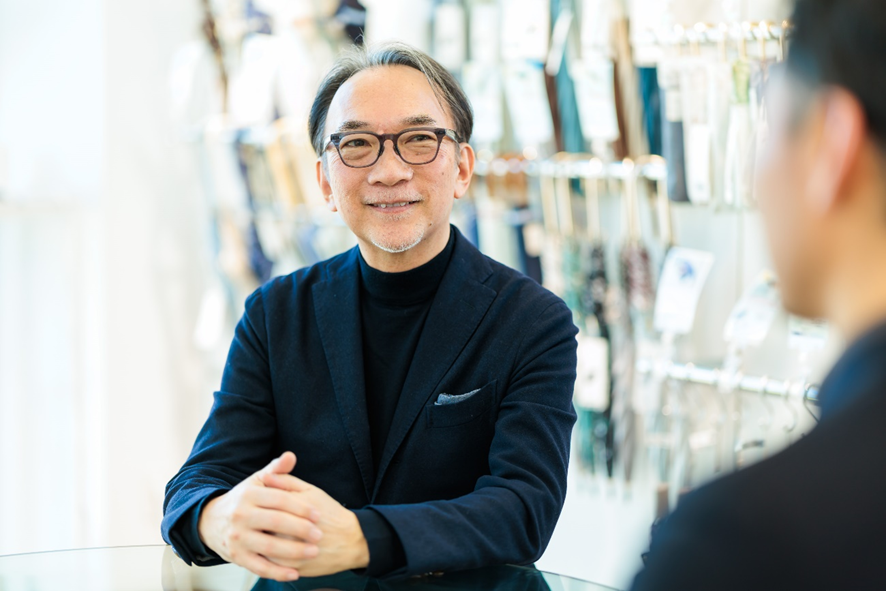
―What is your impression of Mr. Tsuboi’s coaching?
Yoshino In Mr. Tsuboi’s coaching, my original self is increasingly drawn out while talking. From there, things are organized and I can see various things anew. When I can feel that “my thoughts deepened today,” I feel very refreshed. My vision opens up wide and I immediately want to start working, thinking, “I’m going to do this!” What’s different from consulting with fellow managers is that instead of seeking the other person’s opinion to learn, the effect is that you face your own thoughts and clarify what you yourself truly feel you should work on.
Tsuboi The protagonist is always Mr. Yoshino. It’s important that Mr. Yoshino’s “forward movement” in action and “forward heart” in emotion are progressing. I want to offer something that goes beyond organizing thoughts to where he has the leeway to see further ahead or where future actions are more likely to be born.
Promoting Necessary Self-Reform for Managers Through the Power of Inquiry
Yoshino Shortly after starting coaching, I mentioned that I’m “getting old” several times. I intended it as a way to hide my embarrassment or just as casual words, but Mr. Tsuboi told me I shouldn’t be saying that (laughs).
Tsuboi Yes. At that time, I felt that by inserting the factor of “age” when Mr. Yoshino made a judgment, he was unconsciously applying a brake. Mr. Yoshino is constantly evolving, yet using that as an excuse or, conversely, using his career as a shield to keep those around him at a distance could lead to negative outcomes. I told him that because I wanted him to challenge himself more boldly toward the person he wants to be, and I thought it was my role to release that brake.
Yoshino It struck me that I was the one deciding my own limits. Since then, I’ve sealed those words within the company as well. I was grateful that he said exactly what needed to be said in a soft and polite tone.
Tsuboi I, for my part, learned from Mr. Yoshino’s humble attitude.
―How do you feel about the significance of managers spending time on coaching?
Yoshino Managers tend to rely on past successful experiences, but they must continue to update themselves according to the trends of the times and the stage of the company. When you have moved through several companies like I have, past successful experiences and know-how may be acquired naturally, but the “ideal image” is something that should be constantly updated. You need the power to redesign each time without fixing your style strictly. Reforming oneself each time without relying on the past—isn’t that a necessary quality for a manager? This coaching, spanning 26 sessions, supported exactly that “power to change.”
―Finally, if you were to express the value of coaching in one word for you, Mr. Yoshino, what would it be?
Yoshino For me, coaching is time to find and draw out the self I want to be. I felt firsthand that even for someone who has built a certain career, reviewing oneself is extremely meaningful. I am convinced that the humility to view oneself objectively and continue self-reform is the only way to lift a company to the next stage. To maximize this value, it is probably important for experienced managers to have an attitude of receiving it flatly and without pretension. Spend more time thinking about the “now” and the “future” rather than past achievements. Since I realized it is very effective for remaining a manager who continues to grow with a future-oriented mindset, I definitely want to recommend it to managers around me.
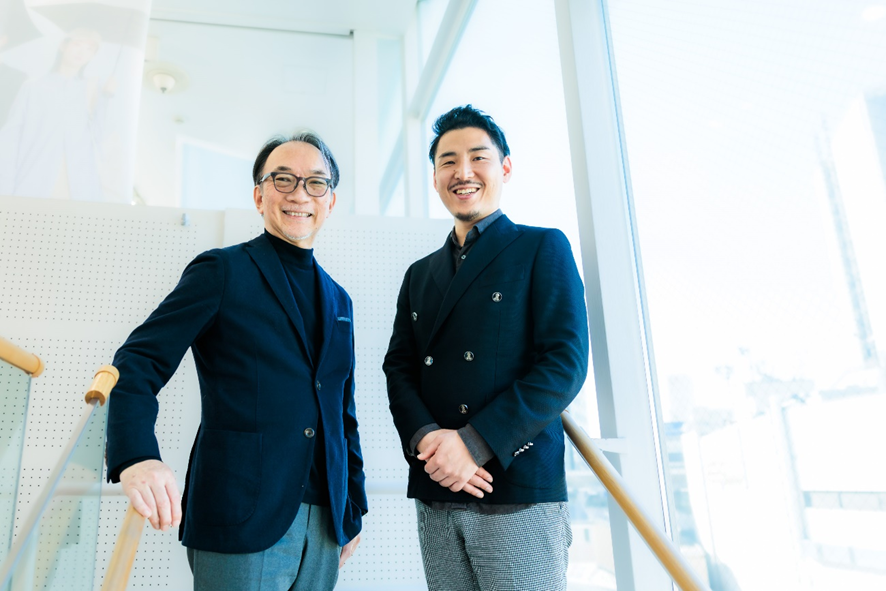
Tsuboi I’m truly happy that I was able to accompany Mr. Yoshino, who continues to face his own growth sincerely while producing wonderful results as a manager. Thank you very much.
-
The Reality of Venture Support
Polishing Products Together and Accelerating the Business: EventHub’s Challenge, Backed by JAFCO’s User-Centric Support
-
The Reality of Venture Support
True Partnership in Uncharted Territory: The Challenge Behind the World’s First Space Debris Removal and the Journey to the IPO
-

The Reality of Venture Support
How to Apply "Leverage" to Both People and the Organization: The Role of HR Support in Enhancing Portfolio Company Value
-
The Reality of Venture Support
An IPO Is Just a "Milestone": Behind the Scenes of Back-Office Support Aimed at Increasing Portfolio Company Value
-
The Reality of Venture Support
The Basis of Support Is Creating Business Opportunities—How We Create That Crucial "First Meeting" for Startups