
Interviews with Portfolio Companies
Life is Tech: A Startup at the Crossroads of Education and Technology
#Startup's Challenge
Jun. 04, 2025
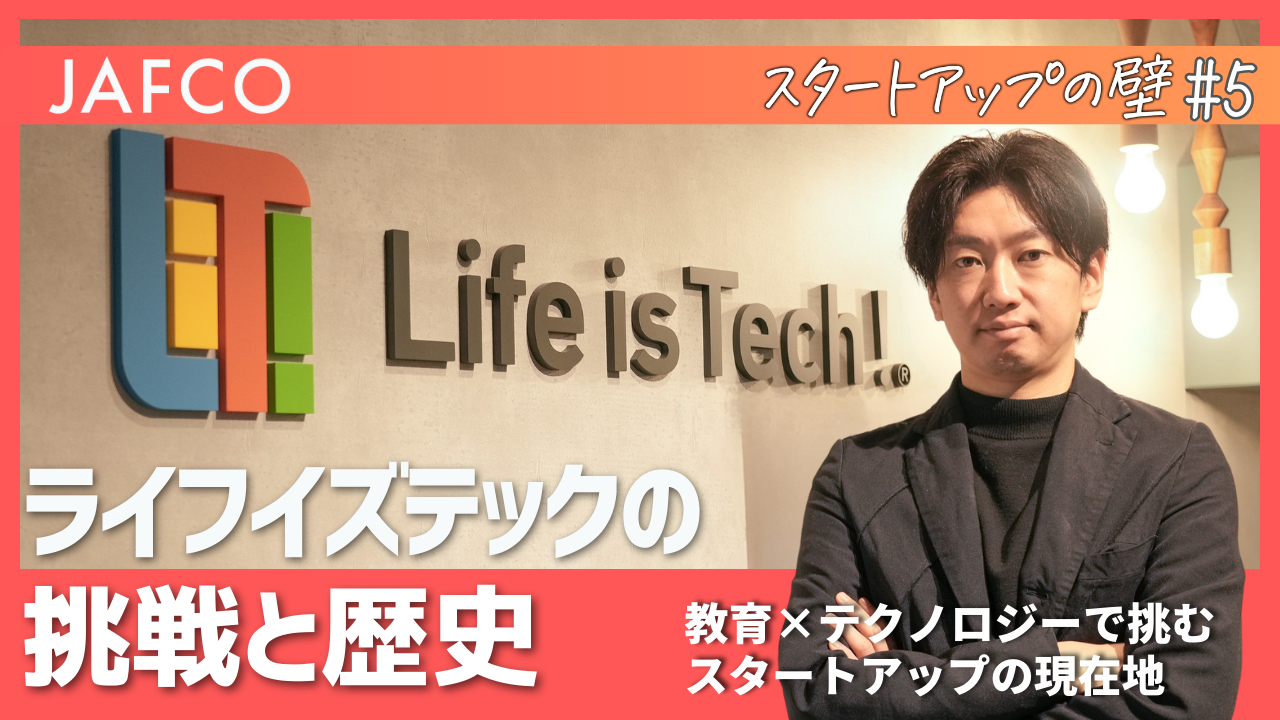
About Life is Tech, Inc.
Life is Tech operates with the mission of “maximizing the potential of as many junior and senior high school students as possible.” Centered around digital education for teens, the company also develops educational programs for university students, working adults, corporations, and local governments, providing programs and ecosystems for nurturing the next generation of digital talent. In 2011, it launched its IT camp and school for junior and senior high school students, “Life is Tech!” Later, it released the cloud-based teaching material “Life is Tech! Lesson” for junior and senior high schools in response to the move to make programming a required subject. As of August 2024, it has been introduced in 4,400 schools and 600 municipalities nationwide (as of August 2024), and continues to grow.
[At the time of interview]
Founded: July 2010 / Year: 15th / Number of employees: 139 / Total funding: Approx. 6.7 billion yen (at Series E funding)
The Startup Challenge: Life is Tech
We interviewed Life is Tech about the challenges that startups face. What follows are summaries of the five videos from the company we’ve delivered so far.
Founding Story
Driving Social Change Through a Mission — How to Create an “Impact Startup”
Speaker: Yusuke Mizuno, President & CEO, Life is Tech, Inc.
Yusuke Mizuno graduated from Keio University’s Faculty of Science and Technology and completed his graduate studies at the same university. While in graduate school, he spent two years as a part-time physics teacher at Kaisei High School. After working at a human resource consulting firm, he founded Life is Tech in 2010. Focused on a combination of education and technology for providing life-changing learning to every junior and senior high school student, he collaborates with various companies and local governments to foster the next generation of digital entrepreneurs who will work to make society better.
Passion for Education Reform and the Roots of Life is Tech
Life is Tech is gaining attention as an “impact startup” that achieves both business growth and solutions to social issues. Its mission is to maximize the potential of as many junior and senior high school students as possible. President Mizuno started the company in 2010, driven by strong concerns about problems in the Japanese education system, such as the focus on average scores and the difficulty in nurturing individual strengths and personalities.
At its founding, the company ran summer IT camps for teens, aiming not only for skills acquisition, but also to provide a life-changing experience through encounters with college student mentors and peers who share their interests, and helping students gain a sense of purpose in life. It later expanded into school-based programs and began developing online learning environments to eliminate regional and economic disparities in education.
While diversifying its educational initiatives, such as through collaboration with Disney, the company released a SaaS product for teachers following the 2020 policy requiring programming in schools. This service has been adopted by about one-third of junior and senior high schools nationwide and is used by over one million students. The company has also expanded into corporate training.
Evolving as an “Impact Startup” and Future Strategy
President Mizuno describes an “impact startup” as a company that seeks both business growth and positive social impact. Life is Tech has always prioritized building a better society for the next generation, beyond the pursuit of profit, and has valued alignment with shareholders who empathize with its mission when raising capital.
Since its founding, Life is Tech has been mission-driven. It defines the evolution of its business as: 1.0 = Changing the lives of the children right in front of us; 2.0 = Delivering learning opportunities to more children online. Currently, it is aiming for a new goal: to develop innovation-minded individuals, that is, those who believe they can change society, reaching 20% of junior and senior high school students, or 1.2 million people, by 2025. Looking toward 2030, the company plans to evolve into 3.0.
President Mizuno emphasizes that, for startups, a deep commitment to solving social issues and strong products that realize that vision are essential. As a leader, he believes it is important to remain mission-focused and passionate.
For more on this vision and commitment, please see this video (the video is in Japanese).
The COVID Challenge
Overcoming Hardships with Ideals and Teamwork — Two Essential Qualities for Startups
Speaker: Yumi Nishimura, Head of Member Success Division, Life is Tech, Inc.
Yumi Nishimura is a graduate of the College of Education at Yokohama National University. She is certified as a high school information technology teacher. From the very day she interviewed for an internship at Life is Tech during university, she has consistently been involved in its camp and school programs. She assumed her current position in July 2021. Working at the forefront of innovation education, she continues to refine the LX (Learning Experience) that brings out the full potential of each junior and senior high school student.
Challenges During the Pandemic and the Move to Online
Life is Tech had been operating short-term, intensive programming camps for teens. However, during the COVID pandemic, participation in its largest event, the camp, dropped to one-third of previous levels. Because the company had placed great importance on in-person gatherings that foster interaction and excitement among participants, measures like mask-wearing and social distancing became a major barrier that threatened the foundation of the business. At first, it was an extremely difficult situation, as they could not see what could be done or what the right course of action was.
However, motivated by the desire to give students who had signed up for spring break camps and long-time college mentors their final opportunity to participate with a smile, the team started to ask what they could do. With the support and input of many people, they decided to take on the challenge of going online. After the March camps were canceled due to COVID, they worked intensively to prepare an online version of the experience by May, completing it within just three months to match the quality of the offline events.
Until then, most camps had been held in limited areas like the Tokyo metropolitan and Kansai regions, but going online allowed participation from rural areas and even overseas, significantly lowering the barrier to entry.
How They Overcame the Pandemic with Ideals and Teamwork
At first, it was difficult to recreate the excitement that had been so important to the offline experience. Through trial and error, they built a new experience from scratch, listening closely to participant feedback and exploring new ideas, such as using Zoom breakout rooms for small-group activities, adjusting how breaks were taken, and maintaining participants’ focus.
As a result, they succeeded in creating the same level of enthusiasm in just three months, despite the challenges of COVID. During the final presentation of the Golden Week online camp, many students said it was “just as fun as being in person.” This moment confirmed the potential of the online format.
The online expertise gained through the camp program continues to be used in the school program today. Nishimura notes that their ability to overcome the pandemic was largely due to a strong determination not to stop the learning opportunities for teens and an unwavering commitment to their mission. She says they learned that even in tough situations, there is nothing they cannot overcome if they put their heads together and work as a team.
Looking ahead, she says their goal is to nurture globally active talent, like an “IT version of Shohei Ohtani.”
For more on their journey in recreating the excitement of offline experiences online, please watch this video (the video is in Japanese).
The New Business Challenge
Those with the Most Accurate Firsthand Information Will Win — A Strategy for Delivering New Value to New Customers
[Speaker] Noriyuki Marumoto, Executive Vice President and Chief Education Strategy Officer, Life is Tech, Inc.
After graduating from the Faculty of Letters at Keio University, Noriyuki Marumoto joined Link and Motivation Inc., where he worked in organizational and HR consulting. After joining Life is Tech, he managed the camp and school programs before launching a new business targeting schools and boards of education in 2020. This initiative led to the introduction of the SaaS-based programming curriculum “Life is Tech! Lesson”. He now leads the business as Executive Vice President, Chief Education Strategy Officer, and Division Head.
A New Way of Delivering Value in a Changing Educational Landscape
Life is Tech has expanded from B2C services like camps and schools to new business areas such as EdTech SaaS products for schools and digital talent development consulting for local governments. This shift was driven by both internal and external factors: internally, the original business model was labor-intensive and seasonally variable, prompting a need for more sustainable growth; externally, there was a major shift in education with the introduction of mandatory programming instruction.
However, providing services to new customers (schools and local governments) posed a very high hurdle. Entering a new market, as framed by Ansoff’s growth matrix, meant they had to understand local government procedures and customs. Despite interest in the business, they faced barriers to concrete implementation.
How They Raised Their “Resolution” of Firsthand Information to Succeed
To overcome this challenge, Life is Tech placed utmost importance on enhancing the “resolution” of firsthand information—through extensive interviews and immersive involvement with their customers (teachers and boards of education). Beyond conducting surveys and interviews, they visited real classrooms, observed actual lessons, and even taught classes themselves. This allowed them to identify points of improvement and uncover the latent needs of their customers.
One example was learning that teachers had only brief moments between classes to record student progress, leading to efforts to create more user-friendly UX design.
Through team-wide trial and error in an uncertain environment, they found their first breakthrough with pilot cases in places like Nara City and Ritsumeikan Moriyama High School. These successes encouraged further expansion to other schools and local governments. As of now, “Life is Tech! Lesson” has been adopted in about one-third of the 15,000 schools nationwide.
Marumoto says his future vision is to make education into one of Japan’s export industries. He passionately speaks of exporting the know-how of “people development” (transforming the world through digital) in collaboration with schools and local governments, particularly to English-speaking and Asian countries where digital talent is in short supply.
To learn more about how Marumoto overcame the challenges of launching new businesses, this video (the video is in Japanese)
The Diversification Challenge
The Secret to Successful Business Diversification — How to Develop a Repeatable Strength
Speaker: Yuta Komori, Co-Founder and Executive Vice President / COO, Life is Tech, Inc.
Yuta Komori is a graduate of the School of Science and Engineering at Waseda University. After working at a human resource consulting firm, he served as a content director at SCRAP for real escape games before co-founding Life is Tech. He proposed the concept of LX (Learning Experience), a learner-centered approach that incorporates entertainment into education design, and continues to pursue innovative education services through both online and offline platforms.
The Background and Development of Business Diversification
Life is Tech was founded in 2010 with a passionate mission of transforming education. It began with a B2C camp business for junior and senior high school students.
Business diversification was not part of the original plan. For the first seven to eight years, the company focused on its core education programs for teens, gradually expanding in response to emerging societal issues and needs, always considering how their involvement could be meaningful. The company placed particular emphasis on the quality of educational experiences and was committed to creating impactful learning environments. Through this, they realized that their educational programs could truly be life-changing for students.
Driven by the desire to provide these experiences to more people, they began exploring online initiatives. With the times changing and challenges such as the requirement for IT education in schools and a shortage of teachers becoming more visible, the company expanded into B2G services for municipalities and schools. Furthermore, as students who had grown through Life is Tech began entering society, the company recognized that there were few pathways available for these talents to apply their abilities.
This led to the decision to transform the company into one that could also support digital talent, marking their entry into B2B training services for corporations.
From PoC to PMF: Repeatable Strength as the Key to Diversification
When launching new businesses, Life is Tech began by conducting PoC (Proof of Concept) experiments to confirm whether there was a genuine societal need and whether that need could be felt through conversations with customers. Once a need was identified, they decided to “just give it a try” and proceeded to scale the initiative into a full-fledged business.
However, the path from PoC to PMF (Product-Market Fit) was challenging, especially in terms of customer acquisition and ensuring the repeatability of quality. Because of the high-context nature of their services, it was difficult to identify the right customers. Eventually, they narrowed their focus to industries such as manufacturing where digital transformation needs were clearly emerging and this strategy led to their current growth.
Although they are still in the process of fully achieving PMF, Komori says the strongest sense of PMF came when they were able to build organizational repeatability, that is, when new team members could perform well in sales and delivery (implementation) in a short time, allowing the service to scale as more people joined. This, they believe, is an important indicator of PMF.
He also explains that Life is Tech’s core strength lies in this very repeatability, and to ensure it, they prioritize recruiting team members with shared values and a strong sense of purpose. Additionally, clearly articulating how to maintain consistent service quality is also crucial.
Komori says the key to successful diversification lies in thoroughly identifying and refining the assets they already possess. This clarity of purpose leads to a strong sense of intention, which, in turn, empowers the company to diversify, expanding into corporate training and exploring new areas of education.
Looking ahead, Komori hopes to apply the educational know-how Life is Tech has cultivated to address structural problems in society, including offering career education for university students. He also mentioned a new challenge: founding a school, with the aim of transforming junior and senior high school education even more directly and meaningfully.
To learn more about Komori’s insights on creating repeatable strengths, watch this video (the video is in Japanese).
The Future Challenge
Stagnation Is an Opportunity — How to Overcome Slow Business and Unlock the Future
Speaker: Yusuke Mizuno, President & CEO, Life is Tech, Inc.
Lessons from Failure and Habits of an Entrepreneur
Since founding the company, President Mizuno has emphasized being present at the frontlines, deeply understanding the needs and emotions of customers, including students and teachers, and incorporating those insights into product development. This has been key to the company’s growth.
However, he reflects on a past failure: in a collaboration with Disney, they developed an online system based on the idea that a high retention rate means more sales. This assumption, he admits, was flawed.
From that experience, he learned the importance of carefully considering who the product is for and who the true customer should be with a high degree of clarity. Today, he places even greater value on listening closely to voices from the field. He believes that temporary stagnation is when the seeds of regrowth can be found. His approach is to search for ideas that not only solve problems but also simultaneously promote growth. Ideas that can deliver both outcomes are, he says, the key to reigniting business momentum.
As an entrepreneur, he also prioritizes maintaining his physical health to make good decisions, staying updated with new perspectives from overseas, and learning about innovations like AI, all as part of a commitment to continual self-improvement.
Aiming for a Global Future
President Mizuno identifies “the overseas challenge” as a clear obstacle they must overcome. Just as Sony brought innovation to the world, he hopes that Life is Tech can bring innovation to the field of education and ultimately positively impact more than 100 million children worldwide, becoming a truly global company.
To achieve this, he believes that building a strong foundation in Japan is crucial. Specifically, he is promoting a “3 x 30%” strategy: developing three business pillars, each with a 30% operating profit margin. By focusing management resources on existing and new domestic businesses to secure a strong competitive position, they aim to establish a stable financial base before launching new products and expanding overseas again.
Although Life is Tech previously operated in the US for about five years and ultimately withdrew, they learned a great deal from that experience. The next international expansion may not necessarily be in the US. Mizuno says they will carefully assess the situation and move forward at the most appropriate time.
To learn more about President Mizuno’s mindset for shaping the future, watch this video.
Recruitment Information
Life is Tech is actively strengthening its recruitment and organizational structure for further business growth. If you are interested, please visit Life is Tech’s recruitment page.
- Company website: https://life-is-tech.com (in Japanese Only)
- Recruitment page: https://jobs.life-is-tech.com/ (in Japanese Only)
Related Articles
-
Interviews with Portfolio Companies
A New Start for Matchmaking Leader Omicale.Creating Romantic Encounters Together with Local Governments and Companies
-
Interviews with Portfolio Companies
The Challenge of a Rare Independent Inspection Gauge Manufacturer: Manufacturing That Supports Production Floors Through Greater Efficiency
-
Interviews with Portfolio Companies
Transforming Society Together with Financial Institutions: A Fintech Startup Aiming to Establish a New Financial Ecosystem
-
Interviews with Portfolio Companies
Make "Caritas Job Hunting" No. 1 employment media. Decisions to maximize the company's potential
-
Interviews with Portfolio Companies
Choosing an AI startup with 53.3% revenue growth rate and IPO ambitions; Achieving discontinuous innovation through strategic capital/business alliances